My family has a passion for the performing arts. Seeing live theater, performing, and (in my case) helping in the concession stands at the local high school production.
In my county, there are several regional theaters that have top-notch local productions. Very gifted people perform and produce these shows. I’m very lucky to say that all three of my kids have had the opportunity to participate in these productions.
I was once speaking to a gifted producer who helped run a number of phenomenal plays and musicals in my area. My son was playing a role in one of his plays and the producer asked me how my son’s line memorization was going.
My son and I had been running through the lines together just the night before. And to be honest, it was still a little rough. I told the producer that we were working on it, and while he was getting the spirit of the character and the lines, he wasn’t word for word yet.

The producer thought for a moment and said that there are plays that require word-for-word recitation. Shakespeare must be performed as it is on the page, or the meter is lost, the wordplay, the feel is gone. While other plays are really improv sessions, where a loose framework guides the emotion and characters. But ultimately, the performers can respond to how their character would react without being beholden to the text.
Think of how cooking is different from baking. When you’re cooking a meal, you may be out of a particular ingredient – but substitution can be just fine. If you’re baking and you’re out of eggs – you’re not going to end up with the cake you planned.
The key for a performance that was true to the production was to know whether you were playing improv or Shakespeare. Or somewhere in between.
A Good Framework Guides and Inspires
Good frameworks are powerful ways to organize your thinking and your teams to do more. They don’t require you to obsess over one vendor’s approach to marketing. They don’t constrain you in artificial and counter-productive ways. Rather, much like a garden trellis – or the outline of an improv scene – they give you support to build strategies and programs that support your broader priorities.
Good frameworks are also adaptable. They aren’t so rigid that they can’t change as your needs or the market changes. But at the same time, they need to be relatively constant so you can build long term strategies around them. A framework that is constantly in flux doesn’t let you or your teams think deeply about what to do next and commit to executing on the marketing plan.
The model I use is called Money Marketing. Your application of it will be unique. Your practical use of it will vary from company to company. But at its core, it is unchanging. You can use the exact same model successfully for the rest of your career, and it will be fundamentally the same.
What is Money Marketing?
When I looked back on all of the strategies and approaches that I’ve applied in my career. Those that I’ve hacked into place and those that I’ve learned from better and wiser marketers than me. Those that have succeeded and those that have, well, been lessons learned. Across all of these strategies, the successes were fueled by five key elements.
And, since we’re in marketing, we need a fun acronym so it’s easy to remember. The five elements are:
- Make the Market: Understand the pains, needs, and future needs of your ideal customer and the people within that customer.
- Own the Narrative: Build a story based on these present and future needs that paint you and your customer as the heroes.
- Net More Clients: Create a funnel process that uses urgency to propel prospects to become customers.
- Expand Your Customers: Develop customers into raving enthusiasts that want to help others get the value they’re experiencing.
- Your Team: Support your people with clear goals, effective work, and a radical focus on their development.
Let’s talk through each of these elements in a bit more detail.
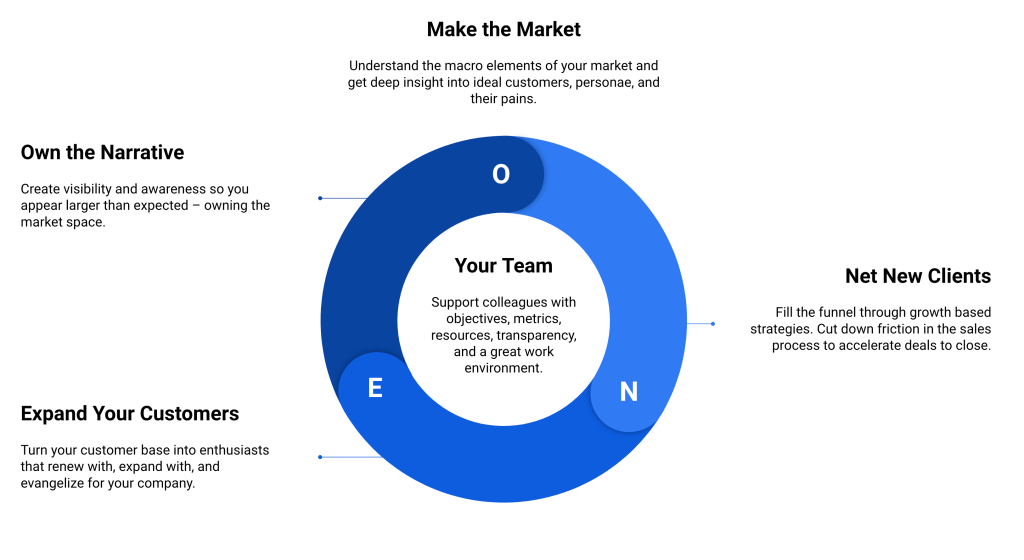
Make the Market
Everything starts with your customer. A deep, thorough knowing of their needs and pains. An understanding not just of today’s problems. You need to know where the market is heading and what customers’ future needs and pains are likely to be – or can be made to be.
You must identify the attributes of businesses that most feel the pain or need. Or, are likely to feel these challenges. You need to then go deeper within your target businesses to understand the roles and titles of people within these businesses that will champion and buy your offer. Understanding your buyers is the foundation on which the rest of your strategy is built.
You will also need to understand the context of your market. That includes evaluating competitive offers that are direct or adjacent alternatives. Competitors could be other businesses, internal options, or, most deadly, inertia.
The context of your market includes other attributes like government or industry regulation. It could include macro-shifts like population or demographic changes, legal shifts, and technological leaps. All of these elements will adjust how you market.
Ultimately, these macro-shifts are a powerful force for you. Connecting your strategy to a major movement gives you a force-multiplier. Buyers are more likely to be compelled by large market forces. You also have to do less to motivate buyers to change. And, as we’ll see in the next section, it helps you weave a compelling narrative.
As we’ll discuss in more detail in other posts, when you are working through this section, you’ll be establishing the bedrock of your strategy. You will have in place the offer you want to make to the market, the ideal customer and who is your buyer, and the context in which you operate.
More information about the making the market step in your marketing plan.
Own the Narrative
Once you have established the foundation of your marketing plan in the Make the Market section, you’ll move on to owning the narrative. We’re social creatures, us humans. We want to tell and hear stories. They excite and engage us. And they connect us all to something bigger.
You’ve likely seen other companies successfully own the narrative by transcending the tired, rational, feature / benefit paradigm. Features and benefits are useful in the right context. But they are rarely going to motivate people to stand up for your offer when budgets are getting cut.
Some narratives are about the offer itself. Like Apple’s ‘it just works’ narrative. The idea that user manuals should be largely unnecessary is woven into every product. A story could be about a company’s founding or founders, the way you often hear companies like Drift leveraging the past success and continuing vision of David Cancel.
A story could be about the macro-trends mentioned in the prior section. Linking a company to a macro-trend allows you to take advantage of press and other influencers’ work in promoting a challenge or opportunity. Like, say, the rise of artificial intelligence. You then link your solution as the on-ramp to that opportunity, as we’ll see.

Choosing a niche story that is of interest to a small number of people can be effective, particularly if your product itself is niche. But often picking a broader story and bending it to suit your niche is more effective. Consider companies like Terminus or 6Sense. These companies began as tools that helped marketers to advertise to target accounts. They linked themselves to the Account Based Marketing trend. A trend which was far more comprehensive than their initial offer. But that was fine. They owned the narrative and shaped it to focus on what they did well. Then, they grew their platforms to support the broader narrative over time.
Coming up with your narrative is only the first part of the process. You’ll then want to know how to communicate that narrative back to the ideal customer that you’ve already identified. You’ll want to bake that narrative into every communication, consistently and frequently. So, buyers will come to associate your brand with the trend.
More information about owning the narrative.
Net More Clients
You might be thinking to yourself, ‘when are we going to talk about lead generation?’. That’s the core of marketing, isn’t it? Well, traditional approaches do tend to concentrate heavily on lead or demand generation. And there’s a good reason for that – it’s where sales come from. But without the prior steps in your strategy, you will be blocked from building a sustainable model for netting more clients. You’re likely going to be locked into desperate tactics like buying leads or gimmicky approaches.
Luckily, by following the Money framework you have the basis for a more effective lead generation. Why? Consider outbound approaches for a minute. What’s a more effective way to spend the time of your sales and sales development people: randomly choosing targets to pursue based on Fortune 1000 lists or ill-defined ideas about chasing hot accounts? Or, prioritizing accounts that have the attributes you’ve defined as being the right kinds of customers? Of course, when you complete the first step of making the market, you get a radical focus for your teams.

Similarly, when you work on owning the narrative out of the gate, you set yourself up for more effective outbound. You know yourself that you’re much less likely to take a prospecting call from an unknown company. But one that is respected and known by you? Yes, you’re much more open to taking that call.
That applies to inbound too. But wait. Isn’t inbound just about producing content and waiting for people to arrive? Yes and no. When you complete the Make the Market stage first, you understand the pains and needs of your prospective customers and the people within. That lets you build targeted content that is valuable to your audience.
And, as you probably guessed, owning the narrative helps you for inbound as well. A well-crafted narrative allows you to produce content and get into channels that your prospects care about. That means more prospective accounts are likely to inbound to you.
This section of the marketing plan is more than inbound and outbound to generate prospects. It’s also about reducing frictions in the buyer’s journey. After all, it’s not enough for marketing to generate leads and then throw them over the wall to sales. A great marketing plan is built on netting more customers, so marketing has to be a strong partner for sales.
That partnership comes through many deliverables. High quality, well-qualified leads that don’t waste sales’ time are important. That might come from effective qualification by marketing engines, sales development, or even trialing or usage of your product.
The partnership can be further strengthened through resources and tools that help, or enable, sales teams to be more effective. From smart pricing to competitive tear-sheets, to compelling presentations.
More information about netting more customers.
Expand Your Customers
Once you’ve landed new clients, are you done? Of course not! Existing customers are too valuable of an asset to be underused. Marketing is, at its core, about increasing the value of your business. That value comes from increasing ownership of the market in terms of visibility, impact, and revenue.
When you consider ownership of the market, start with the obvious metric of revenue-based market share. That is, how much of the total addressable market do you serve on an annual basis. There is a certain safety that buyers gain from going with the dominant player in the market. You don’t get fired for buying IBM, as they used to say, back when IBM was a market leader.
Your customers are also a recurring source of revenue through repeat purchases, subscriptions, upsells, and expansions. These add up but they don’t do so magically. They require an offer that fulfills a key need that you effectively communicate to your customers.

Marketing plays a vital role in this process. Creating great offers and products that existing customers need and see value in. Communicating the offers to your prospects and ensuring that they know that they are with a winner.
Beyond revenue there is an additional value that comes to you from your customers: visibility and awareness. Highlighting your ownership of the market through customer testimonials and other approaches give your prospects comfort via social proof of your value.
Consider how much prominence is gained from leveraging customer logos, evangelism, and more. Prospects see the social validation that comes from your existing customers and fear missing out on being themselves a leader.
More information about expanding your customers.
Your Team
How does all of this thinking, planning, and executing get done? It’s not going to be you on your own – at least not in the long term. It’s you and your team. I’m sure you’ve heard the management mantra of ‘hire smart people and then get out of their way’. That’s well-intentioned, but wrong-headed. You need to hire smart people and support them in critical ways.
Hiring is one of the most important decisions you can make. Great hires can have a massive impact on your business’ effectiveness. And poor hires will distract you, drain you and your team, and ultimately need to be corrected. Choose your new hires very wisely.
When hiring, as we’ll explore in more detail, you need clear job descriptions and clear expectations. You need a strong hiring process that looks beyond high profile schools and the shiny names of previous employers. You need to look past how well people interview to look for intangibles about their ability to operate in complex, shifting environments.
Now that you’ve hired a great team, just get out of their way, right? Not so fast. Your primary function as a team leader is to provide the mission, goals, work expectations, processes, and resources that enable your team to be effective.
This is a constant effort. You should be constantly engaged in helping your team to be more effective. This isn’t micro-managing your colleagues. This is creating an environment where they themselves can make smart decisions quickly. You need to hire smart people and then get the crap out of their way.
More information about building a great team.
A Framework within a Framework?
Now that we’ve discussed the key elements of the Money Marketing framework, let’s take a step back.
The acronym that organizes the framework is MONEY. But there’s actually another level of acronyms within the acronym. Very ‘Inception’, I know. On the bookends, you’ve got M and Y. They are outside the middle because they are the constant strategic focus that you need to have as a leader. I always want to spend as much time as possible thinking about the market, where it’s headed, and where I can help direct it to.
At the same time, I want to be constantly aware of my team and how I can support them. That includes clear goals, metrics that are well understood and achievable, and the power to advance their career – whether with you, another team, or another company.
So, that’s why these two components are MY priority.
Framed by MY in the MONEY acronym is another acronym: it’s ONE. Here is the flywheel that is constantly spinning, generating awareness in the market that leads to more wins and to expanding, successful customers. You use the ONE elements to generate, convert, and grow customers. Essentially, these are the ongoing strategies that are constantly producing new campaigns that drive revenue.
So, that’s why these three components are the ONE set of strategies you need to iterate on constantly. Double acronym power!
Let’s Get Started!
Now that we’ve introduced the framework and its components, it’s time to dive into the resources and ideas that will help you to build your unique marketing strategy. No two marketing plans will be the same – just as no two improv shows will be the same. No standard go to market model will apply universally to all customers. But this framework is constant. I hope you’ll use it as I have as you move from company to company and adapt it to support your business and team growth.
 Peter Mollins on Marketing
Leave a comment