
A fantastic Sunday afternoon for me is to go for a walk in the woods with my family and dog. The trail we often go to (The Talking Trees, highly recommended) starts at a small pond. At the edge of the pond is a dock where turtles, fish, and small plants wait for food. The pond is seen below in this fab picture from, I’m guessing, 1999.
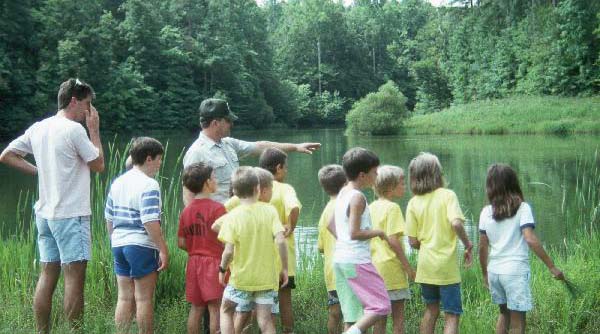
As you continue through a field along a dam, you cross a field with longleaf pines, dogwood, and some poplar. Tall grasses and marsh plants line the water’s edge. Birds patrol the shore and nest in the adjacent trees. The trail snakes through a field into the woods, and you pass by vines, grasses, and small shrubs. The sound of insects buzzing and calling is everywhere.
As you cross the border into the woods, a careful eye might spot voles and mice. It’s a safe bet that you’ll see squirrels chasing each other.
Once you’re in the woods, things change. The plants specialize and colonize certain areas. Flat, dry ground – the pines dominate. Go down into a small hollow, it’ll be dogwoods and poplars. Somewhere in between, you’ll find oaks. The diversity – can I say innovation? – that you saw where the pond met the land or where the field met the forest – is largely gone. Rows on rows of pines stand very consistently.
On the floor of the deep forest, there is life, but it struggles to sprout up in the shade of the tall loblollies. The diversity, the innovation happens where there’s change. It happens where there is a shared edge.
Find Change Where the Forest Ends
We talked about the importance of finding – and riding – a trend. Build your marketing plan on a significant movement in society or the market. That lets far more powerful forces than your marketing budget do much of the heavy lifting for you. The media will promote you indirectly via the trend. Even the general zeitgeist in the market promotes you via your trend. And if you’re helping to shape the movement, you’ll be thought of first by journalists and prospects looking for an opinion on the shift.
There are many ways that you’ll want to leverage a trend. In the ‘owning the narrative’ section of this program, we’ll talk more about how to build the storyline behind the trend. For this section, we’ll focus more on the idea of figuring out what trend you want to leverage.
The reason you want to know the underlying trend is simple. It’s the same reason you would want to know which way a river is flowing before you start paddling. Market forces will push businesses and the people that work at them in predictable directions. Not everyone will move. And not everyone will move at the same pace. But important trends will move many of your potential customers. Your job is to figure out (roughly) where they are headed.
When you know the direction of the powerful tide, when you can see the outline of the distant island we’re being swept toward, you can help direct where we make landfall. You can even be there ahead of others, helping businesses to navigate the new terrain. In summary, you can be one of the winners.
So, how do you find your trend? I think you need to do it by looking back to the forest trail. The diversity, or opportunities for growth, happened where the marsh became the field. And the field became the forest. Looking at trends, I like to look for a trend that is coming to its end. What has lost its energy and is ready to be replaced by something else? Or, look for the intersection of multiple trends as a way to see a shift that is multiplied by multiple forces.

There are two primary ways that you can start to figure out the trend. Choosing which path will depend on how far along your actual solution idea is.
Backing Into a Trend
You may already have an idea for your business and what you plan to offer to the market. In that case, you might think that you’re pretty much done with this stage. However, there’s so much more that you can do here.
Let’s say that your business manages health savings accounts for employees on behalf of their employers. Your business earns more whenever an employee signs up for and uses an account. Now, you could simply leap to the stage of identifying and communicating the value of having a health savings account. You could start talking about how your employee portal is better than alternatives.
Or, you could take a pause and consider the broader trend.
Why do employees need one of your accounts? The rising cost of healthcare is one reason. This has been a long term, persistent trend. If employees are concerned about the rising cost of healthcare, are there related services around healthcare cost management that they might benefit from?

If costs continue to rise as a share of income, employees will continue to shift where they want to work to companies that provide better benefits. So, providing a health savings account becomes a vital way for employees to stretch their health spending. It becomes an important tool for employers to attract and retain their employees.
Suddenly, the notion of a trend – the rising burden of healthcare costs and its importance to employees’ choice of where to work – becomes more apparent. Even if you didn’t actively consider a trend when generating the idea for your business, there’s likely one in there.
Stepping Into a Trend
The reverse situation is an equally valid starting point. You might not yet know what your business idea is. By assessing which way trends are going, you can generate ideas for what kind of business you want to form. Here are a few of the underlying forces that you can think through. Though it is definitely easier if you have a general idea of the space you want to focus on, say, health.
A fascinating part of thinking through these forces is how it can shift your thinking of who your market is. Maybe you are considering a business related to commercial real estate. So, your first idea is to build a network of independent commercial realtors in your hometown. But as you start considering demographic trends, you realize that commercial real estate in your home town is shifting from manufacturing to distribution because of labor shortages and a change in demand.
Now, this blog is not intended to be a market research planning site. So, I won’t go into agonizing detail on how to assess the various trends. I will give you a few ideas, though, to help you surface trends that you might want to mine.
Demographic
These are shifts in terms of population sizes or key characteristics. They can be useful because different cohorts of ages, for example, have different needs.
So, in the United States and many other industrialized economies, there is a significant aging of the population. This has come about due to the maturing of the Baby Boomer generation and the increased (until recently) longevity of people on average. This trend can have a variety of impacts, like urgent needs around healthcare, later retirement, and more.
You might think about shifts in terms of where people live. Increasing numbers of people are moving from high-cost cities to lower-cost regions. A sub-trend among some age groups includes movement into cities to live. Assessing these trends can help you to spot business opportunities or markets to target.

Cultural
Shifts in cultural norms are another important trend. These can be movements of people, for instance. So, again in the United States, the growth of Spanish-speaking populations doesn’t only mean opportunities for providing services in another language. It also could be addressing the subtle shifts in culture that people from Spanish-speaking regions bring. That could include changes in food preferences, sporting enthusiasms, and more.
Cultural shifts can also be less apparent. Consider the general shift away from communal activities toward more individual ones. This was captured back in the 90s with Faith Popcorn’s notion that video rental stores were a reflection of people ‘cocooning’ into their own homes. The streaming movement and personal entertainment devices are merely this trend further developing.
These trends can also relate to the workplace. Shifts in norms around working with remote employees enabled in part the outsourcing boom of the 2000s. And it continues to be felt today as COVID restrictions accelerated domestic remote work.
Economic and Political
Changes in government policy, distribution of wealth, and other factors can yield economic trends that you should monitor. Government policy around credit availability can be a short term trend that you cannot rely on for long term choices. But longer term shifts, like the general directional focus on lower taxes and less regulation is one.
You might look at the distribution of wealth and recognize a trend that you want to explore. For instance, the movement of wealth out of major cities toward regional poles as demographic shifts happen. Or, the opening up of the stock market and greater democratization of access to financial vehicles more sophisticated than a savings account.
Shifts in policy often lead to markets changing slowly and then suddenly. Consider the green economy. While slowly building demand and supply for solar, wind, and other alternative energy sources led to a move toward renewables, but hardly an overwhelming move versus carbon-based energy sources. But in recent years, increased demand, government support, and, critically, a decline in the cost and a rise in expertise for renewables has led to their blossoming.

Technological
You may also look at general shifts in technology over time. These could be gigantic, obvious trends like the rise of the internet or the mobile shift. They could be less titanic, like the improvement in voice recognition. Regardless of the scope, these technological changes can have a major effect on how you decide to execute your marketing strategy.
Consider the rise of better voice recognition. Initial applications of it tended to be around saving time for desktop tools. Like, avoiding typing through voice transcription. But as recognition improved in quality, it became apparent that many Star Trek-like uses were opened. In some use cases, inputting information through voice was faster and more convenient. At the same time, we also learned that voice has its place, as typing remains faster and often more aligned with how people think and process in many cases.
The Forest Edge is Your, Well, Edge
As you consider each of these trends there’s likely a voice in your head that’s saying: ‘sure, if it were that easy, I would have predicted the rise of e-commerce and made a fortune’. That’s true, it’s not easy to get ahead of individual trends. You may not have specialized expertise or access to that kind of knowledge to stay ahead of trends.
However, that doesn’t matter. Because innovation flourishes where the marsh meets the field. It flourishes at the edges.
To determine the trend you want to ride, start running through a series of thought experiments. That means taking a set of trends that you care about, particularly from different categories, and see how they constrain each other.
Consider a cultural trend that you are interested in, say the aging of the population. Now, apply another edge to it, like say the technological trend of voice recognition. Maybe add another edge, like the cultural trend of people being more isolated and inward-looking. What does the combination of those three things bring to mind for you?
Maybe it’s voice-based assistants that are geared to seniors? Maybe it’s simple video communication for connecting with family? It might be tools that help call centers recognize age differences in voices? Perhaps it’s a new design for senior centers?
By combining multiple trends together, you’re able to create more ideas for the angle you want to focus on. And as we’ll see later, your unique take on the trend or trends will make for a highly compelling story. Let’s go!
 Peter Mollins on Marketing
Leave a comment